
Meet the speakers: the people moving research from the page to the frontline
11 Aug 2026
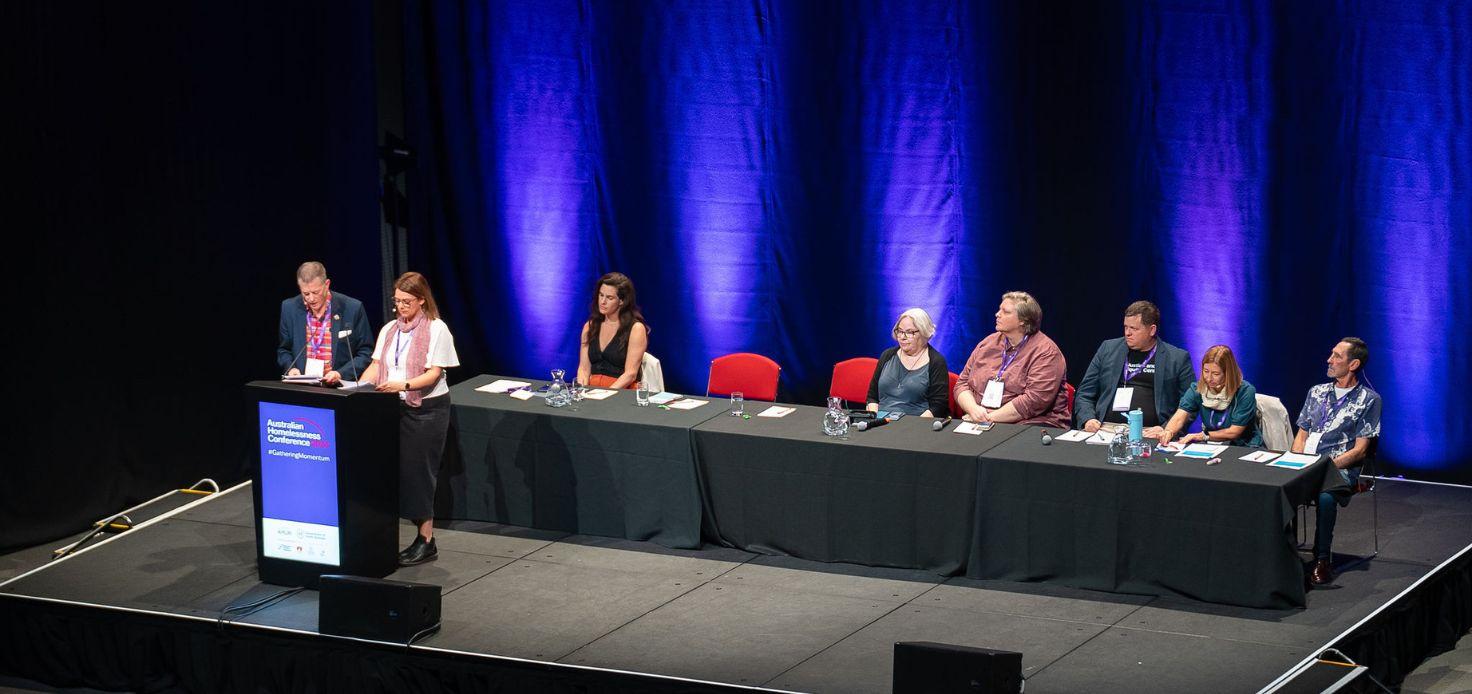
Attendees at previous Australian Homelessness Conferences told us they wanted to hear more from researchers, and how research can be tailored to work with the sector, rather than dictating to it. We listened.
This session brings together three of Australia’s most prolific university research leads and a regional leader from Mission Australia, to explore how academia, homelessness services, and people with lived experience can partner in research — turning shared efforts and insights into strategies that move the needle.
A first job that shaped decades of research

Robyn Martin, Professor of Social Work/Associate Dean, RMIT University
Robyn Martin’s first job was at a women’s refuge, and it taught her a lasting lesson: the importance of lived experience. It has become a guiding principle for her academic work for over two decades.
It also made her a natural fit to lead the 2024 AHURI-funded project Lived experience participation and influence in housing and homelessness policy, service design and practice — the first Australian study to explicitly examine the role of lived experience expertise.
"In many research contexts, meaningful participation of people with lived experience is seen as difficult and resource-intensive," Professor Martin says. "This can discourage researchers from engaging with people with lived experience or adopting authentic co-design approaches."
Professor Martin’s presentation will outline methods that ensure authentic engagement with — and leadership by — people with lived experience.
"Changes can come down to something as simple as interview guide language. During our recent research, we thought our questions were accessible, but our lived experience leaders said: 'that's not language we use – we say it this way' – and it changed the guide completely."
Professor Martin will share practical steps for collaborative homelessness research, backed by real-world examples from her work.
A career with roots in Australia's most isolated communities

Gwion Cain, Regional Leader in North Queensland, Mission Australia
For 15 years, Gwion Cain lived on 48 acres in the Daintree Rainforest in Far North Queensland. This experience fostered a deep appreciation for the land, its history, and its Traditional Owners.
In 2009, Gwion began his career as a regional real estate licensee, where he witnessed the barriers First Nations peoples faced in private rental markets, employment and education. Motivated by these inequities, he became a Trainer and Assessor in 2011, working across First Nations communities where English was often a third or fourth language and community Lore, guided by Elders, shaped daily life.
His work took him throughout remote Australia, including the MacDonnell Ranges west of Alice Springs, the eastern and western capes, and the Torres Strait Islands. He also served for two years as Queensland Regional Manager for Men's Shed Australia.
This role reinforced a key lesson: effective support must adapt to culture, not expect culture to adapt to support systems.
“During that time, the Royal Flying Doctor Service delivered mental health services in Cape communities, but many First Nations men would not access them because of stigma,” Gwion says. “The Men's Shed provided an alternative.”
Through practical activities such as woodwork and vehicle repairs, local men built connections and engaged in conversations with counsellors in a culturally safe environment.
“Rather than imposing Western models and KPIs, service delivery was shaped around community preferences and cultural appropriateness.”
Gwion brings these insights to his presentation, which will examine a co-designed Mission Australia and AHURI research project exploring the long-term housing outcomes of people who accessed Mission Australia’s homelessness services in Cairns, around three-quarters of whom were Aboriginal and Torres Strait Islander peoples.
Attendees will gain insights into the project’s key findings, the methods used to maintain longitudinal participant data, how Mission Australia is applying the lessons learned to improve service delivery, and where service users’ voices were central to the project’s success.
Lessons on working with tech: neither saviour nor scourge

Professor kylie valentine, Director of the Social Policy Research Centre and the Centre for Social Research in Health, UNSW
Homelessness services help people survive and find stability — increasingly by navigating a maze of eligibility rules and paperwork, now made trickier through the compulsory use of online forms, multi-factor authentication, chatbots and apps.
This shift demands new skills from people experiencing homelessness and from services, kylie valentine argues.
“We need to move past seeing technology and AI as either fantastic or terrible,” Professor valentine says. “My presentation is about the importance of recognising how people are actually negotiating technology and where administrative rules and online systems don’t work for people.”
Professor valentine researches integrated service delivery across family and community support, gendered violence, housing and homelessness, and alcohol and other drug services.
In this session, attendees will hear about possible futures, how things could be done differently, and the importance of research partnerships.
“There’s plenty of evidence for what happens when tech-types embark on projects without guidance from the sector, or knowledge of the sector’s particularities,” Professor valentine says.
“There are already lots of websites and apps, and a lot aren't very useful because they assume people need information, when what they actually need is practical support,” Professor valentine says. “There are also countless AI fails, from hand dryers that don't recognise black skin to data biases that lead to inappropriate profiling.”
Attendees will hear why the homelessness sector needs a dedicated research program on technology.
Utilising data to better understand homelessness

Associate Professor Stephen Whelan, University of Sydney
Stephen Whelan researches housing assistance and labour market outcomes, housing tenure and mobility, older Australians' housing outcomes, and first home purchase financing.
He will present a new analysis offering deeper insight into what causes and triggers homelessness — insight that could point to better policy responses.
The analysis used the Person Level Integrated Data Asset (PLIDA) — a large-scale ABS longitudinal dataset combining Census and administrative data on health, education, government payments, homelessness and demographics.
“Previous homelessness datasets have been constrained by small samples that are potentially unrepresentative of the affected population, or have limited information on the drivers of homelessness,” Professor Whelan says.
His presentation will also explore a novel merging of data from Specialist Homelessness Service provider Mission Australia with PLIDA, and the doors such data-merges open.
“We envision a future where we unify more datasets for a more effective data-driven approach to policy making,” he says. “Findings could mean totally different policy approaches emerge.”
“If it is found, for example, that homelessness is often precipitated by a shock-event, like unemployment, that requires a totally different approach to causes that are slower and play out over longer periods.”
Attendees will leave with a sense of how data will shape the sector’s future, and how data-driven decision making could be a new tool in services’ toolbelts.
These are just a few of the 150+ speakers presenting at Australian Homelessness Conference 2026 in Darwin on 7-8 October.
Conference registration includes access to all plenary, major concurrent and concurrent sessions, as well as the Welcome Reception at the end of day one (two-day registrations only). A range of registration packages are available, with reduced rates for not-for-profits, concession and lived-experience attendees, and groups of 3 or more.